Min arbetsplats Batteri Arholma har blivit omnämnd i media tidigare. Den senaste artikeln kan läsas via Svenska Dagbladet.
About me

- Vladan Lausevic
- Stockholm, Sweden
- My academic blog with history, primarily military history as the main theme. Please leave a comment that can be relevant and useful for the topic which you find interesting. I am writing in several languages, including English, depending on the theme and the languages of the sources. At the moment I am working as guide at Batteriet Arholma military museum in Stockholm. For further information please contact me on lauvlad89@gmail.com
tisdag 5 september 2017

tisdag 29 augusti 2017
Civilizationism instead of nationalism?
Recently I read the
article ”Between nationalism and
civilizationism: the European populist moment in comparative
Perspective” written by Rogers Brubaker, one of the more known
experts in nationalism. In short, Brubaker argues that nationalist actors in Northen and Western parts of Europe are going beyond
nationalism in their political communication. Such actors are referring to what
Brubaker defines as ”civilizationism”. In such political communication, as a
religion, Islam is seen not only as a threat to a political community as a
nation but also to what is understood as ”our civilisation”. Brubaker argues
that this kind of communication consists”identitarian Christianism”, secularism and liberalism that are
combined in the national populist narratives.
The contemporary right-wing or national populism in Europe is often based on the two
sides of ”us and them” world views. In the vertical
dimension, it is about the narrative of ”people
vs elite” by using expressions such as political correctness or corrupted elite.
While in the horizontal dimension it
is about aspects that are seen as ”against
our way of life” as immigrants, Muslims, globalization, EU. These narratives
are also combined by for example presenting ”the elite” as ”careless cosmopolitans” or as ”traitors” who favour refugees instead of ”our own people”.
Much of such combined narratives is relating to views on Islam and Muslims.
Brubaker argues that the shift from
nationalism to civilizationism is based on such views and perceptions,
where Islam is seen as a ”civilization
threat”.
One of the early
developments took place in Netherlands, with Pim Fortuyn, one of the most
famous populist political actors in Europe. Fortuyn combined anti-Islam, or in modern sense islamophobic rhetoric,
with sociocultural liberalism. He referred to himself as ”Samuel Huntington
of Dutch politics” and spoke about ”clash of civilizations. His perceptions
were based on forming views about
European Christian identity while at the same time embracing secularism,
liberal values, gay rights, gender equality, freedom of expression. Brubaker
writes that the concept of civilizationism is using and presenting Christianity,
secularism, and liberalism in the following ways:
a) Christianity = not
as a religion but as a civilizational identity opposed to Islam
b) Secularism = as a
way of minimizing the visibility of Islam in the public sphere.
c) Liberalism = gender equality or freedom of speech as “our” way of life in opposition to
Islam.
A similar case can be observed in France. Historically the Front
Nationale party was using antisemitism in its political communication while
the current leader Marine Le Pen has adopted an Islamophobic stance. For
example, the NF communicates about ”Christian values” while at the same time embracing secularism, the lacité, often with
references about Islam and Muslims presented as a problem for a secular society. Brubaker writes that such political communication as in France
and Netherlands is taking place in parts of Europe, as the North and Western
Europe, which are considered to be among the most secularized and non-religious
regions in the world. One
explanation is that many Europeans equate secularism with modernity while
religiosity is equated to backwardness. Christianity among the European
national populists is not seen as a religion but as a ”secularized Christianity
culture” and as ”identitarian or civilizational Christianism”. In the sense
that if ”they are Muslims, we have to be Christians”. Basically, Christianity is not presented as in opposition to
secularism. It is presented in combination with secularism as opposed to Islam.
Brubaker also writes about political shifts when it comes to
secularism. Historically secularism was more connected to socialist and liberal
actors while the conservative ones favoured religiosity. Today in Europe, communication about secularism is more connected to right-wing
actors while left-wing and or liberal ones are often in favour of social harmony and
religious diversity. Or when it comes to symbols and practices in the
public sphere. For example, in France, the NF is presenting itself as a
secularist party, despite its own history of being a party against secularism and in favour of a Christian country, society. The party has been communicating
about perceived problems with Muslims openly praying on the streets, halal meat
or with women with headscarves.
Liberalism is also being used by national populists. The transformation of several national populist actors as in Austria or France has been a shift
from antisemitism to philosemitism and also by presenting themselves as committed to aspects as gender equality and women’s rights. In practice it means that Jews are now presented as fellow Europeans
who, as well as women, are under threat from Islam. Gender equality is often
presented as a national value that has to be defended from the outsiders,
Muslims. Above the nationalist views, there are also civilizaionist
ones where gender equality is presented as a European, Western, or even as Christian values in opposition to Islam.
Another case of such communication is
what today is called homonationalism. It is about communicating about the need
to protect the gay population from Muslims or homophobic immigrants, where
”they” are presented as backward and intolerant while the nationalist actors
present themselves in favour of tolerance, openness and civic rights. This is
also an electoral strategy for nationalist actors in order to attract votes
from other groups and actors in society. And last but not least, such
actors present themselves as defending the freedom of speech. But it does not
mean defending the freedom of speech in general, instead, it is about standing
up for freedom of speech when the communication is directed towards or against Muslims.
What is important to be mentioned is
that Brubakers description is limited and focusing on North-West European national
populists. In comparison between the
NWE populists and those in Central Europe as in Hungary and Poland or as with
the case of Trumpism, there are considerable differences. For example, when it
comes to the views on liberalism. For more information and knowledge, click here
in order to download Brubaker’s article.
torsdag 24 augusti 2017
Neo-functionalism and early intergovernmentalism
In this series of texts, I am writing about my research regarding the contemporary debate when it comes to the neo-functionalist regional integration theory.
When it comes to the development of the spillover effects, the
neo-functionalism has been based on the prediction that interaction between sectoral
spillovers would lead to the political spillover resulting in the new methods
of governance. When looking on the development from European Coal and Steel
Community to EU the neo-functionalism have in several ways “predicted” the
integration process. Not only when it
comes to economic governance but also to the geographical aspects. Haas also argued
that cooperation between one group of member states would lead to other states
“joining the club”.[1]
For the neo-functionalism this was confirmed during the beginning of 70’s
when the UK, Denmark and Ireland
became member states of the European Economic Community.
However, during the earlier Cold War period, the neo-functionalism became
questioned during several occasions. One example has manifested in the
political behaviour of the French president Charles de Gaulle, who on two
occasions vetoed UK
application for the membership (1963 and 1967). During 1965 there was a case of
“the empty chair crisis”, with France
not being officially represented in Council’s meetings, marked by de Gaulle’s
intergovernmentalist approach and resistance towards supranationalism.
Basically, France
was absent from the meetings within the Council of Ministers as a protest to
what was perceived as a centralised majority voting system. The “crisis” was solved by the so-called “Luxembourg
compromise” which meant more intergovernmentalist form of governance.
Institutional powers of the Council were increased but with unanimity as basis
for decision-making process. The member states were also given veto rights to be able to veto proposals from the commission. This development also
leads to the idea of Common Agricultural Policy (CAP) not being developed as a supranational one and instead being developed into intergovernmental one.
The 70’s marked the end of Europe’s
“Golden Age” period of economic development starting from the middle of the 1950’s.[2]
Namely, during the economic, financial and social developments in the 70’s,
such as the oil crisis in 1973 and Bretton Woods, the financial system was
dismantled, and protectionist measures and temptations became more politically
popular in the community. The period from the middle 1970s until the first
part of 1980s became later famous as the “Euroclesoris”. The community’s
development was often regarded as stagnating but not as disintegrating. Among
the problems for the neo-functionalist theory were the “deadlocks” of the
Council meetings and institutional relations with the UK as well as
that the political development of the community was often based on the
political disagreements.[3]
It was during this period and “spirit of the time” that the
intergovernmentalist theoretical approach started to be developed and gain
popularity.
Stanley Hoffmann, through his intergovernmentalist critique of the
neo-functionalism approach, emphasised the importance of the national
governments and their political roles in shaping the community’s structure,
governance and decision-making process.[4]
One of Hoffman’s arguments was that national governments would always endorse
their interests within the polity. He also argued that the logic of political
diversity limited the spillover effects, implicating that the neo-functionalism
had its limitations. Hoffmann also highlighted the dichotomy between low politics and high politics. In low politics, such as economy, the national
governments were more interested in transferring sovereignty to a supranational
institutional, while in high politics, for an example foreign policy, the
development was the opposite one.
For the neo-functionalism, this became visible when it comes to the
aspects of political behaviour of the governments of the new member states as Ireland, Denmark
and the UK,
as the states were more interested in persevering sovereignty over what they
regarded as “vital” interests. At the same time, during the 70’s, the
neo-functionalism was marked by the formation of the European Council which had
impact of further integration process and of the European Political Cooperation
framework, the predecessor of Common Foreign and Security Policy.[5]
[1] Moga
p.799
[2]
More information and explanation of the
term ”Golden age” can be found in Economic
Growth in Europe Since 1945 by Nicholas Crafts, Gianni Toniolo (Cambridge,
Cambridge University Press, 1996)
[3] Moga
p.800
[4] Sandholtz, Wayne & Sweet, Stone Alec. Neofunctionalism and
Supranational Governance
(unabridged version). Downloaded: 2017-02-24.
Publication date: 2012-01-01. Website: http://digitalcommons.law.yale.edu/cgi/viewcontent.cgi?article=5636&context=fss_papers p.3. Hoffman presented that ”classical
concerns” of European politics such as political worry for sovereignty and
rivalry between the states, even in Western Europe, could be part of European
level governance and decision-making process.
[5] Moga p.800
måndag 31 juli 2017
Neo-functionalism and functional federalism
In this series of texts, I am writing about my research regarding the contemporary debate when it comes to the neo-functionalist regional integration theory
Already from the beginning, within the framework of functional
federalism, an idea that later could be labelled as “constitutional design”,
existed.[1]
Haas viewed the “Monnet method” as technocratic and functionalist being “rooted
in preferences and hardnosed self-interest among policy actors in Europe ”.[2]
For Haas, who developed his works in the middle of
1950’s, the argumentation has been based on the idea that when economic cooperation reaches a certain level it will transform into the process of
political integration in order to solve
political and economic issues caused by the economic integration. [3]
The early
neo-functionalism was based on perspectives of the importance of political
support for the economy, including setting the aims and objectives, the scope
of operations, the definition of functions and the establishment of power structures,
the consensus in the decision-making process and also relevant institutions and
processes for the external relations.[4]
In addition, there is a similarity to the
presentation of Monnet’s “functional” or “gradual” federalism.[5]
The view of functional federalism involves the idea of “Europe ”
or “community” that, over the course of time, becomes more politically
integrated and unified. The notion of functional federalism also stresses its
relevance when it comes to governance, policymaking and decision-making
process. Since the polity that is governed is regarded as ”a transnational
society”, it also includes the argument that the polity needs governance where
the authority of decision-making is performed by a supranational institution.[6]
This is opposite to intergovernmentalist views which present the EU as a kind
of political experiment of sharing and pooling sovereignty, and without
institutional transferring from states into a single supranational polity. As
Moga points out, both neo-functionalism and intergovernmentalism are the
macro-level theories of international relations, designed to describe, clarify
and predict the European integration process.[7]
For the neo-functionalism the process of further and closer integration
is theoretically based on different “spillover effects”, meaning that
integration in one political sector such as economy, leads to integration in
other sectors as well. The original neo-functionalist view was based on and
explained by the institutional development of European Coal and Steel Community
(ECSC) and establishment of the following institutions:[8]
- Special Council of Ministers (predecessor of the
Council of Ministers)
- High
Authority (prototype of the European Commission)
- Common
Assembly (78 members, later developed into the European Parliament)
- Consultative
Committee (corporatist, later became the Economic and Social Committee)
- Court
of Justice for settlement of disputes. (later European Court of Justice,
nowadays the Court of Justice of European Union)
Over the course of time, the performance of these institutions produced
spillovers, according to neo-functionalist and functional federalist views.
There are three main different types of spillovers:
1. Sectoral (or
functional), meaning the spillover process from one policy sector to another,
such as from agricultural policy to harmonization of transport policy or from
customs union to monetary union.
2. Political
spillover, meaning an increased level or process of “politicization” of the
sector itself, such as for example transformation from coordination of monetary
policies to a central authority as European Central Bank.
3. Geographical,
which has not always been recognized in research as one of the main types. Geographical
spillover consists of the enlargement process of a regional polity as the EU is
getting more integrated and enlarged by the new states.
[1]
Rosamond, Ben. Theories of European
Integration. (New York , St.
Martin ’s Press, 2000) p.50-51
[2] Ibid
[3] Moga p. 797-798.
[4] Chen, J. Robin, Chin, M. Joseph
& Tang, Chih-Min. “Globalization, Regional Organizations, and the Facets of
Higher Education: Taiwan
[5] Moga. p.797-798.
[6] Ibid
p.798.
[7] Ibid
p.797
[8]
Ibid p.798
lördag 8 juli 2017
Debating the neo-functionalist theory. From the period of coal and steel to the Eurozone crisis - Intro
In this series of texts, I am writing about my research regarding the contemporary debate when it comes to the neo-functionalist regional integration theory.
Is neo-functionalism still relevant for understanding the EU:s
development as a process of regional integration and function of a supranational
polity? Even Ernst B. Haas, the “father” of the neo-functionalism has, during
his research in the 1970’s, raised the question of its relevance.[1]
To understand the theory of
neo-functionalism, it is vital to understand the theory of functionalism,
which was developed during the 1940s and 1950s. Another vital aspect of
being considered is the relevance of neo-functionalism is the political work of Robert Schuman and Jean-Monnet, often presented in literature as the “founding fathers” of the European Union and of the “functional federalism”.[2]
being considered is the relevance of neo-functionalism is the political work of Robert Schuman and Jean-Monnet, often presented in literature as the “founding fathers” of the European Union and of the “functional federalism”.[2]
The functionalist theory was for many years challenging the contemporary
and dominating theoretical approach in the field of international relations - realism.
The original realist scholars, as Hans Morgenthau were state-centric orientated
and emphasised the notions of national interests.[3]
They argued that, within the framework of international relations, states were
the dominant actors with no-shared values between themselves. Also, they argued,
and still do, that a political development outside of the state is equal to
anarchy. The “father” of functionalism David Mitrany published his famous work
on the theory of functionalism, A Working Peace System. An Argument for the
Functional Development of International Organization in 1943.[4]
Mitrany projected his views as a universal solution for relations between
states, something that opposed the ideas of realism. His arguments and findings
have some similarities to the later ideas of Monnet and Schuman regarding the
development of governance above the state level. The central theme of Mitrany’s
work was “cooperation”, and also the formation of international cooperation was
emphasising on universal (in modern term global), instead on a regional polity
and governance.[5]
The main difference between functionalism and neo-functionalism is,
therefore based on the degree and character of the institutional framework. While functionalism
has been based on the cooperation between the states, the neo-functionalism
turned to be based on the integration of the states into a larger administrative
unit. In his book The Uniting of Europe
(1958), Haas
wrote about his ideas and the differences between the views of Mitrany
and Haas can be easily identified already in the title of their publications.[6]
While Mitrany was emphasising the cooperation and using the term “international
organisation” Haas is emphasising the integration and “uniting” Europe in a political way, by the process of regional
integration.[7] Mitrany argued that the design of functionalism
was about focusing on promoting economic cooperation based on the premise of
mitigating financial conflicts and pursuing shared interests among the states. Mitrany`s
writings during and after WWII expressed his views that the political
sensitivity of vital issues and continuous continue political integration
would inevitably lead to wars. Therefore, the process of cooperation was
preferred as the answer. Mitrany also referred to the notion of collaboration and
functionalism as the process of “federation in instalments”. Also, there was a
fear that attempts to achieve “European unity” would lead to problems of
nationalism but on a larger scale.[8]
When it comes to the theories of European or regional integration, the
neo-functionalism is the part of “the supranational family”, as opposed to the
perceptions and arguments of functionalism that is theoretically closer to the
intergovernmentalist views (cooperative). For Haas, regional integration in Europe has been viewed rather as a political process than
a technical or functional one. In his book, he defines the process of
integration as: “political integration is
the process whereby political actors in several distinct national settings are persuaded to shift their loyalties,
expectations and political activities toward a new center, whose institutions
possess or demand jurisdiction over the pre-existing national states”.[9]
By such way, the neo-functionalist school also came to challenge the state-centric
framework of realism. In their research Shen and Xu argued that the
neo-functionalism developed the following directions of a “pluralist” theory,
based on the critique of realism:[10]
1)
The concept of the “state” is more complex than realists suggested.
2)
The activities of interest groups and bureaucratic actors are not confined to
the domestic political arena.
3)
Non-state actors are important in international politics.
4)
European integration is advance through “spillover” pressures
[1] Haas, B. Ernst. The Uniting of Europe.
(Stanford, Stanford University
Press,1958)
[2] Robert Schuman was French minister of Foreign Affairs while Jean-Monnet
was a political economist and first president of European Coal and Steel Union
High Authority responsible for the common market.
[3]
Morgenthau, J. Hans. “The Six Principles of Political Realism”. Publishing
date: Unknown. Downloaded: 2017-01-24. Website: http://www.imas.nccu.edu.tw/Syllabus/%E6%98%9F%E6%9C%9F%E5%9B%9B/34-38Six_principles_of_Political_Realism.pdf
[4]
Mitrany, David. A Working Peace System. An Argument for the Functional
Development of International Organization. (Oxford, Oxford University Press,1943)
[5] Moga,
Lucian Teodor. ”The Contribution of
the Neofunctionalist and Intergovernmentalist Theories to the Evolution of the
European Integration Process”.
Journal of Alternative Perspectives in the Social Sciences (2009) Vol 1, No 3. p. 797-798. Download:
2017-02-24. Publication date: Unknown. Website: http://www.japss.org/upload/14._mogaarticle.pdf
[6] Haas, B. Ernst. The Uniting of Europe.
[7] Here,
the meaning of ”region” is based on Europe as
a continent.
[8]
Tranholm-Mikkelsen, Jeppe. “Neo-functionalism:
Obstinate or Obsolete? A Reappraisal in the Light of the New Dynamism of the
EC”. Millennium - Journal of International Studies 1991 20:1. p.3
[9] Hass
p.18
[10] Shen, Shiyong & Xu, Jing. ”IR Theories Debate
of European Integration”. Open
Journal of Political Science, 2014, 4. p. 217. Downloaded: 2017-02-27.
Publication date: 2014-10-16. Website: http://dx.doi.org/10.4236/ojps.2014.44022
onsdag 31 maj 2017
Visit at the Sri Lankan Air Force Museum
During my stay in Colombo, Mount Lavinia area, I visited the Sri Lankan Air Force Museum. My impression and experience is excellent, I have to say that it was one of the best military history museums I have visited. Among the main reasons are that the museum has around 40 aircraft in its exhibition, it is family-friendly, there is a lovely milk bar and also a flight simulator (as a passenger), and other displays such as for vehicles and small arms. The staff is consisting of very friendly air officers and polity. For more info about the museum, please check it out here.


Also, around and in the museum there is a botanic garden.


Selfie with a DC-3

Inside of DC-3


The Pucara bomber, ground-attack plane was an exciting one for me and felt as more unique. Keeping in mind that it was produced in Argentina and used during the Falklands War. "Not everyday" one sees this type of aircraft, also when it comes to propellers.





Kfir! An Israeli made fighter jet and ground attack plane. Interesting that it was sold to Sri Lanka. Kfir can be seen as an Israeli and upgraded version of the French Mirage plane.


1000 kg!

Equipment for refuelling during flight mode.


Video


MiG-27, another "state of the art" example. Multi-role plane.


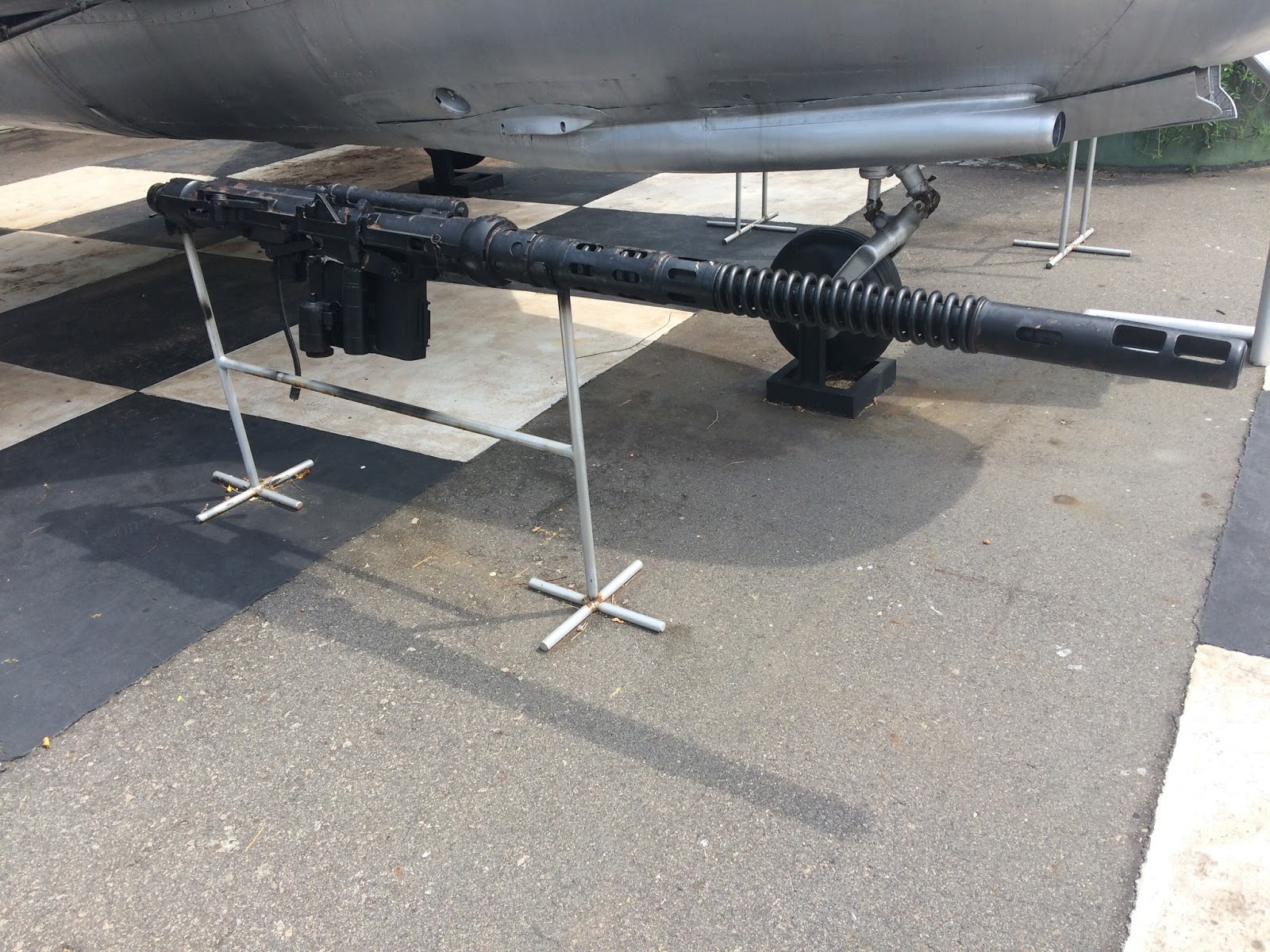
20mm and 30mm ammunition


This one includes a flight simulator as a passenger.


Selfie with a ZU-23, 23mm anti-aircraft gun


SAM-rockets used by the "Tamil Tigers", Russian made SA-18 Igla.

The "black box."

Air camera

According to one guide-officer, this was an example of the "world's first plane", but I forgot the name of it and story, or the myth, behind it.

Playground for children


Exhibition about destroyed items of Tamil Tigers


Interesting warning sign





Engines




Used by the presidents and military commanders


Prenumerera på:
Inlägg (Atom)