About me

Mitt foto
Stockholm, Sweden
My academic blog with history, primarily military history as the main theme. Please leave a comment that can be relevant and useful for the topic which you find interesting. I am writing in several languages, including English, depending on the theme and the languages of the sources. At the moment I am working as guide at Batteriet Arholma military museum in Stockholm. For further information please contact me on lauvlad89@gmail.com

torsdag 3 oktober 2013

Preliminär undersökning för generalstabens studieresor under 1914-1918 / Preliminary examination for General Staffs study tours during 1914-1918


I veckan ska jag bli klar med undersökningen om generalstabens studieresor  under första världskriget. Antalet resor är inräknad från början av 1914 fram till slutet av 1918  eftersom min syfte även var att undersöka det  totala antalet resor under denna period då en sådan undersökning saknas sen tidigare. Däremot rörande perioden 1900-1914 gjordes en undersökning av Christian Sandahl som jag använder som forskningsläge. Hans uppsats handlar om svenska arméofficerares studieresor i Europa och visas i tabellen nedan. 

 Min preliminära undersökning visar att det gjordes runt 49 studieresor. Av dessa gjordes 19 till Tyskland och 17 till Österrike-Ungern medan Frankrike kom på tredje plats med 5 resor. I undersökningen har jag även tittat på antalet studieresor där  väst respektive östfronten besöktes i syfte att studera ställningskrig. Den preliminära undersökningen visar att att östfronten var mer besökt.  


During the week, I will be finished with the examination of the study tours done by the Swedish General Staff during the WWI. The number of study tours is calculated from the beginning of 1914 until the end of 1918. My ambition was also to study the total number of study tours during this period because a similar examination has not been done before. Regarding the period from 1900-1914, a study was done by Christian Sandahl who wrote a paper about the Swedish army officers study tours in Europe which I use as applied research. His examination is presented below. 

My preliminary examination shows that around 49 study tours were done. Nineteen of these were done in Germany, 17 in Austria-Hungary and on third place came France with 5 study tours. In the examination, I also focused on the number of the study tours that were done on the western and eastern front in order to study trench warfare. The preliminary examination shows that the most of the study tours were done on the eastern front. 


1900-1914 Sandahl 
Land / Country
Antal resor 

Number of tours
Tyskland 

Germany 
159
Österrike-Ungern 

Austria-Hungary
  58
Frankrike 

France
  51
Danmark 

Denmark
  34
Belgien 

Belgium
  21
Norge 

Norway
  19
Schweiz 

Switzerland
  19
Storbritannien 

Great Britain
  10
Italien 

Italy 
  10
Nederländerna 

Netherlands
    9
Rumänien 

Romania
    9
Spanien 

Spain
    2
Bulgarien 

Bulgaria
    2
Grekland 

Greece
    2
Portugal 
    1
Montenegro
    1
Osmanska riket

Ottoman Empire
    1

Totalt/Total = 408  


Källa/Source: Sandahl, Christian, ”Att vidga sin militära blick. Svenska arméofficerares studieresor till Europa 1900-1914” i Militärhistorisk tidskrift 1995. ( Stockholm: Nordstedts Tryckeri AB, 1995).


onsdag 2 oktober 2013

Dogs of war


Under 1914 var kapten Ljungberg på en studieresa i Belgien där han studerade användningen av hundar i belgiska armén. Syftet med hundarna var att dessa skulle användas för dragning av kulsprutor på tvåhjuliga lavetter. En liknande metod användes vid denna tidpunkt av nederländska armén. Enligt rapporten är bilderna erhållna från besöket hos 1:a Régiment des Carabiniers. 
Följande bilder visar även reglementet rörande hundar och kulsprutor.


During the 1914 captain, Ljungberg was on a study tour in Belgium where he studied the use of dogs in the Belgian army. The intention with the dogs was to use them to pull the machine guns that were mounted on two-wheeled carriages. A similar method was at the same time used by the Dutch army. According to the rapport the pictures are provided during the visit at the 1: a Régiment des Carabiniers. The following images are also showing manual regarding the dogs and machine guns. 


Dogs of war

Hunden I belgiska armén och kulsprutan av modell Maxim 
The dog in the Belgian army and the Maxim machine gun 


fredag 20 september 2013

Uppsatsskrivandet / Assignment writing


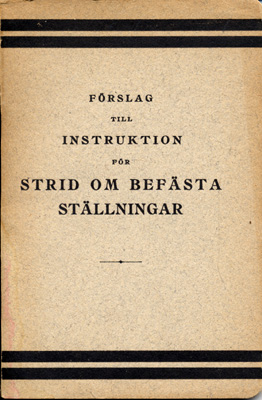
För närvarande rullar det på med uppsatsen. Jag vill avslöja en detalj som är en av uppsatsens centrala delar nämligen instruktionsförslaget som tillkom inom generalstaben under namnet Förslag till instruktion för strid om befästa ställningar. Instruktionsförslaget som  publicerades i juni 1917 var under samt första perioden efter världskriget den viktigaste dokumentet för svenska armén rörande ställningskrig.


At this moment it is going forward with the assignment. I want to reveal a detail which is one of the main parts of the assignment, namely an instruction proposal that was made in the General Staff under the name Proposal for instruction for combat in trench warfare ( I am not sure if this translation is correct or suitable so if you know better please contact me or make a comment). The proposal was published in June of 1917 and was during and shortly after the WWI the most important manual for the Swedish army regarding the trench warfare. 

torsdag 5 september 2013

British Museum Part III. British Museum Del III

During the last time, I have been occupied with the BA-assignment. That is why for that reason only a short comment is published. But as you probably know, a picture is worth a thousand words.


Under den senaste tiden har jag varit upptagen kring uppsatsen. Därför blir denna gång en kort inlägg, men som man säger: en bild säger mer än tusen ord.


From the Pompeii exhibition / Från Pompejiutställningen. 


Political slogans 
                                                                                     Politiska slagord

 No comment 
                                                                                     Inga kommentar.

Undrar hur han tänkte kring kranen 
                                                             I wonder how he thought about the tap

onsdag 28 augusti 2013

British Museum Del II. British Museum Part II

Denna målning föreställer slaget vid Adwa (även känt som Adowa) som ägde rum 1896 under Italiens försök att kolonisera Etiopien  Slaget som vanns av etiopierna blev ett känt exempel inom historien där en afrikansk armé besegrade en europeisk. Den etiopiska segern blev inspiration i många självständighets rörelser under Afrikas koloniala historia. Fram tills Etiopien år 1936 ockuperades av Mussolinis Italien var landet självständig och tillsammans med Liberia de enda afrikanska staterna som aldrig hade blivit koloniserade av en europeisk kolonialmakt. Målningen är från 1940 alltså samma år som den brittiska armén tog kontrollen över Etiopien från italienarna vilket gjorde att landet återfick sin självständighet.

Målningen av slaget påminner om mig kursen i Afrikas militärhistoria på Försvarshögskolan där målningen syns på framsidan av boken ”Wars of Imperial Conquest in Africa 1830-1914” skriven av historikern Bruce Vandervort som är professor på Virginia Military Institute i USA inom modern europeisk och afrikansk historia. Han har skrivit en hel kapitel just om slaget vid Adwa där han skriver nyheten om  nederlaget orsakade oroligheter i flera italienska städer vilket  ledde till att den sittande italienska regeringen valde att avgå . Den nya regeringen sökte medling med den etiopiske kungen Menelik II vilket innebar att koloniala ambitioner slopades. I dagens Etiopien firas fortfarande den 1:a mars som Adwa dagen som är nationell helgdag.  
   

This painting is showing the battle of Adwa (even known as Adowa) which took place in 1896 during Italy's ambition to colonise Ethiopia. The battle that was won by the Ethiopians became a famous example in history where an African army defeated a European. The Ethiopian victory also became an inspiration in many self-determination movements during the African colonial history. Until 1936 when the country was occupied by the Mussolini's Italy, Ethiopia was independent and together with Liberia the only African nations that never were colonised by a European colonial power. This painting is from 1940 which is the same year the British army retook the control of Ethiopia from the Italians which made country independent again. 

The painting remained me about the course in African military history during the studies at the National Defense College where the art could be seen at the front side of the book ”Wars of Imperial Conquest in Africa 1830-1914” written by historian Bruce Vandervort who is professor in Modern European and African history at the Virginia Military Institute in USA. In his book, he has written a chapter about the Italian campaign to colonise Ethiopia. The news about the defeat led to civil unrest in several cities in Italy which led to the resignation of the government. The new government chose to make a treaty with the Emperor Menelik II by that way ending the colonial ambitions  In today's Ethiopia the 1. March is still celebrated as the “Adwa day” which is a national holiday.  


söndag 25 augusti 2013

Resan till London. British Museum Del I Trip to London. The British Museum Part I


Nyligen var jag och min flickvän på semester i London och vi passade på att besöka British Museum. Själv besökte jag även Imperial War Museum som jag kommer att skriva om senare. På British Museum gick vi på en specialutställning om de romerska städerna Pompeii och Herculaneum vilket var helt fantastisk. Det kända vulkanutbrottet från Vesuvius under antiken och dess arv kan nu ses på muséet där artefakterna har lånats från kollegorna i Italien. Här kommer några bilder från besöket. Jag börjar med Egypten.


Recently I and my girlfriend was on vacation in London, and we took us time to visit the British Museum. I also visited the Imperial War Museum, which I am going to write about later. In the British Museum, we went to a special exhibition about Roman cities Pompeii and Herculaneum, which was totally fantastic. The well-known erupt of Vesuvius , and its legacy can now be seen at the museum where the artefacts have been loaned from Italy. Here are some pictures from the visit. I will start with Egypt.


Det var även väldigt intressant att se på utställningen med mumier men just denna lilla mumie var en riktig avstickare. Detta är nämligen en ”fejkmumie” som tillverkades under 1800-talet för att säljas till ”egyptomaniska” besökare.


It was also very interesting to see the exhibition about the mummy. Interestingcially this little mummy was a little bit special. It is actually a “fake-mummy” which were made during the 19-century in order to be sold to the “egyptomanic” visitorsto.


onsdag 7 augusti 2013

Första inlägg - First post


För närvarande skriver jag C-uppsats om Generalstaben. Avsikten är att studera hur Generalstaben arbetade som en lärande organisation.  Med begreppet ”lärande organisation” menas bland annat att organisationen systematiskt och kontinuerligt arbetar med att söka, bearbeta och producera kunskap (jag kommer att förklara begreppet lärande organisation närmare framöver). I det här fallet handlar det om militärt kunskap.  Själva underökningsämnet omfattar Generalstabens arbete med strid vid befästa ställningar, mer känt som ”skyttegravskriget”. Eftersom skyttegravskrigföringen omfattade många aspekter är undersökningsämnet avgränsat till Generalstabens arbeten kring anfall och försvar av en befäst ställning både när det gäller teoretiska arbeten som Generalstabsofficerarnas studieresor till fronterna samt praktiska arbeten som bedrivandet av övningar i ställningskrig. 

Uppsatsen beräknas vara klar innan mitten på september och de flesta källorna som uppsatsen bygger på finns på Krigsarkivet.
For the moment I am writing my paper about the Swedish General Staff.  The intention is to study the Swedish General Staff as a learning organization. The term “learning organization” means among other things that the organization is systematically and continuously searching, analyzing and producing knowledge ( I will explain more about the term “learning organization” later). In this case, it is about the military knowledge. The subject for the study is based on the General Staffs work with the tactics for fortified positions that is more known as trench warfare. Because trench warfare is including huge amount of aspects I have chosen to demarcate the subject how did the  General Staffs undertake the work with assault and defence of a fortified position both when it comes to theoretical task as for example the General Staff officers study tours to the fronts and practical tasks as exercises in trench warfare.

The assignment is expected to be finished before the middle of September and most of the material that assignment is based on can be found at The Military Archives.