On the 31 December
1990 a large number of politicians in Yugoslavia wished Happy New Year to the
citizens and also expressed their hopes for the upcoming year. However, the New
Year celebration became the last one to be celebrated in the country called,
with its full name, Socialist Federal Republic of Yugoslavia. The New Year was
celebrated during a period which by many in the Yugoslav society was
experienced as politically depressing, worrying and pessimistic. By the end of the 1980s
and the beginning of the 1990’s Yugoslavia was influenced by various internal and
external crisis which culminated in the collapse of the federation. Except for the
problems of economy and governance, society’s development was influenced by
growing ethno-nationalism among the different ethnic groups. Political discussions
about reforms regarding centralised or decentralised and federal or confederal
style of governance was by many seen as a polarising issue.
Before
the collapse of Yugoslavia the state was more or less functioning as a
confederation and was a global exception by being the world’s only federation
without being a democracy. During the year 1990, the political conflict between
the nationalists in Serbia and Croatia became more intensified. This was not
only regarding the view of governance where Croat nationalists were more in
favour of decentralization and confederalism while Serb nationalists were more
in favour of centralization and federalism. The political conflict was also
based on the political tensions in for of identity politics between the Serbs
and Croats in Croatia.
One
historical point that often is presented as one of the more important ones when
explaining the collapse of Yugoslavia is the fighting or the clash that took
place in the municipality of Pakrac on the 2 March 1991. The incident was
between the Croatian special policemen and Croatian Serb paramilitaries. It ended
without death casualties and by the action of the Yugoslav federal army taking
over a temporary control over the municipality. The aim of this text is to
connect this occasion to a more central development which explains the reasons
behind the wars in ex-Yugoslavia.
Development
of Serb nationalism in Croatia
Serb Democratic Party (SDS) with Serb nationalism as
the main part of the political agenda, was established in the contemporary
Socialist Republic of Croatia in February 1990. The party had initially a
strong support in the province of Slavonia (not to be mixed with Slovenia) in
those parts of the province where ethnic Serbs where consisting large or
majoritarian part of the local population. One of the most famous and
influential party members Milan Babic participated at the meeting in the city
of Knin on the 17th February 1990. Later in Knin he was elected as a
city mayor. The central aspect of the SDS:s political declaration at the
meeting in Knin was that Serbs in Croatia where under threat of genocide, that
the regional and local administrative borders should be changed and redrawn in
accordance with the ethnic composition, and that territories with a “special
ethnic composition” had the right to proclaim themselves as autonomous after
process of local referendums.[1]
Pakrac municipality was the only one in Western Slavonia where the Serbs
consisted majority of the local population’s ethnic composition. In Pakrac the
local SDS leader was Veljko Dzakula, regarded as one of the most important
persons in the party. One of his famous statements was that if “Croatia leaves Yugoslavia, and
it is working on that daily, then Serbs will secede from Croatia”.[2]
Source:
ICTY
Croat
nationalism and the first democratic and multi-party elections
The first democratic and multi-party elections for
the Croatian parliament were held in April and May 1990. The first democratically
elected parliament came mostly to be consisted by the Croatian nationalist
party Croatian Democratic Union – HDZ (today
a party often labelled as a right-wing, conservative, centre-right party and
member party of European Peoples Party). On the second place were the reformed
communists and among other political actors were the social-liberals and SDS.
Leader of the HDZ was the former army officer and historian Franjo Tudjman who also had a
history of being imprisoned for nationalistic rhetoric during the 1970’s. Because
of the 40% of the votes, his party was able to form the government.
Note
that both SDS and HDZ were presenting themselves as “democratic” parties. In the case of Yugoslavia nationalism was mostly used in order to promote hate and
distrust against another ethnic group, a process resulting in “feeding” the
fear in the society. After the first elections, Tudjman's government started with
a row of actions which were regarded as discriminating by the large parts of
Croatian Serb population. Robert Zimmerman, ambassador of USA, wrote in his
diary about meeting with Tudjman during the 90’s how Tudjman and other leading
nationalistic politicians were open with racist statements about the Serbs.
To
the left - Franjo Tudjman, leader of HDZ. To the right, Milan Babic one of the
leaders of SDS. Source: Wikipedia
The
new government introduced among other actions a higher degree of control over
state and private media, a process that included language purism where
“Croatian words” would be used. Another part of the process was that
individuals who were regarded as disloyal towards the government, Serbs or born
in “mixed marriages” at large numbers were forced away from their jobs from the
state television, radio and security institutions. Other aspects that were
experienced as provocation among the Serb nationalists were the decisions to
introduce a new flag which for many reminded of the pro-Nazi German World War 2
Ustasha regime flag. Another central example was the introduction of a new
constitution which meant that Serbs were no longer recognized as constitutional
group and instead recognized as a minority group. In overall, the political
communication of HDZ during 1990 was more and more perceived as separatist and
in favour of Croatia becoming an independent state. The new constitution also
included texts that in practice meant that Croatia could proclaim itself as an independent state with more than 2/3 of the votes in the parliament. During the
proclamation of the new constitution members of SDS acted by leaving the
parliament in a protest. [3]
”Beam
revolution”
On the August 17th, the Yugoslav air force stopped
three helicopters from Croatia’s ministry of interior. The helicopters were
transporting special policemen to Knin. The chief of the general staff Blagoje
Adzic reported to prime minister Stipe Mesic (member of HDZ party) that the
federal army would intervene if the helicopters did not fly back.
The
reason why the Croatian ministry of interior made the decision to send in the
helicopters with the special policemen was in order to remove the ”barricades”.
Another important reason was to stop SDS politicians from holding local
referendums about “autonomy” in relation to the republic’s constitution. This
development became known as ”balvan
revolucija” meaning beam revolution since the SDS politicians and other civilians
were blocking parts of the road infrastructure where Serbs were in the majority.
The
eastern and south-eastern parts of Croatia were during this time called
“Krajina”. The name means “end “ or “area” and has historical origin from the time
of the Austro-Hungarian empire. Inside of the Yugoslav federal army (JNA) to act
against the armed ethnic Serb civilians but the proposal was dismissed by the defence
minister, general and federal “secretary for peoples defence” Veljko Kadijevic.
However, he did order an investigation about both Serb and Croat armed groups.
One
of beam barricades in Knin area. On the left, a Serb flag is seen and the “four
S” which stand for “only unity saves the Serbs” Source: Sibenik.in
By
Tudjman's government the whole development was seen as a threat against the
authority of the state and against the tourism business because the transport
networks were put under obstacle, obstructed or stopped. For Serb nationalists
the development is seen as a way to show political disappointment towards Tudjman
government and as a sign that the federal government in Belgrade was on their
side.
Development
in Pakrac
Already
during the latter part of 1990, there were armed groups organized by the SDS in Pakrac
area equipped with both military and hunting arms. At the same time the
situation in both Pakrac and several other places was in such order where the
paramilitaries often had a shortage of arms meaning that there were cases where
the majority of the personnel could be unarmed.
In the beginning of February 1991 in Pakrac area there were minor but this time
more equipped paramilitary units organized by SDS. These units were usually
consisted of men in age 18-60 and included members of the SDS, as well as ex-military
and police personnel. The arms were usually hunting rifles and also older type
of weaponry from WWII such as sub-machine guns. A minor part of the weaponry
was provided by the JNA. Between February and August 1991 meetings of the local
SDS-members were regularly held in the village of Kukanjevac.
Before
the shooting took place on the 1st March a meeting was held between the
representatives of the SNV (Serb National Council) and SR Serbia’s minister for
Serbs outside of Serbia Stanko Cvijan. According to the sources used during the
trial procedure at the International Criminal Tribunal for Former Yugoslavia
and what was written in Yugoslavia’s official documentation regarding the
situation Croatia, Cvijan and the local Serb nationalist were discussing about importance
for the Serbs not to “provoke” the conflict. Only if the Serbs were attacked by
the “HDZ forces” the army would intervene and “protect” the Serbs.[4]
Source: ICTY
The
strategy among the Serb nationalists was based on a step by step process of
taking control over the local societies in order to integrate them into larger
political units. During the second half of 1990 those municipalities in which
SDS was in power were proclaimed as “Serb municipalities”. After that the
decisions were taken to integrate them into ”SAO” territorial units, meaning
Serb Autonomous Area. The decision that Pakrac would be ”annexed” to SAO
Krajina was taken on the 22nd of February 1991. On the same day, the decision was also
taken to rename the police station in Pakrac from “Pakrac Police Station” to
“Internal Secretariat for Pakrac municipality”.[5]
Finally
when war was already taking place during summer and autumn of 1991 the SAO:s
units were integrated into a larger territorial unit called Republika Srpska
Krajina – Serb Republic of Krajina, often called for Kninska Krajina or RSK.
The “RSK” came to comprehend around one-third of the territory of today’s Republic
of Croatia. RSK existed from autumn of 1991 until the summer of 1995. It was never
recognized by any other sovereign state, not even by Federal Republic of
Yugoslavia during Milosevic government. Milan Babic was the first president of
RSK and was put on trial after the war accused of war crimes by the ICTY. He
was sentenced to 13 years prison sentence and spend his last days in the prison
when he died on 5th of March 2006.

The municipality of Pakrac is based in Western Slavonia. Serb Republic of
Krajina comprehended during the period 1991-95 around one-third of the territory
of today’s Croatia. As a political and territorial unit, it ceased to exist in
August of 1995 after the operation “Oluja” (Storm) by Croatian armed and police
forces. Source: Wikipedia
The
role of the JNA
JNA- the Yugoslav People’s Army (also known as the
federal army) had two official assignments as a state institution – one
internal and one external. The external institutional assignment was to act
against a conventional or unconventional counterpart in case of war or
violations on the territory of the state. The internal assignment was to function
as a “state holding” institution in order to be used for social coherence,
against actors considered as hostile toward the state, and for occasions as
natural catastrophes.
Within
the JNA leadership during the beginning of the 1990’s there was a high degree of
opposition and hostility against the new governments in Slovenia and Croatia
which were perceived as separatist. One aspect that was perceived as
problematic was that Tudjman’s government was developing and equipping
Croatia’s police and security forces. This was seen as hostile actions, sign of
separatism and being against the political structure and existence of the
Yugoslav federation.
At
the same time JNA was during 1990 acting in such way by presenting itself as a
“neutral” actor by referring to its role as an institution that was
representing all the Yugoslavs and keeping the country unified. This was one of
the reasons why JNA in many situations as during the beam revolution did not
want to present itself as a federal institution that was on the side of Serb
nationalists. However, one thing that JNA did during May of 1990 was to order
to Croatian state to hand over all the weapons and ammunition in hands of
republic’s Teritorijalna Odbrana (TO-Territorial Defence) to the JNA. Large
parts of weapons and ammunition was moved to JNA storages in places where the
Serbs were the majoritarian population.
The
role of the DB
In
Yugoslavia every republic had its own security service. One factor that has been described for having a central role in the
conflict between Serbia and Croatia was the DB which stands for Državna
bezbednost and was SR Serbia’s security agency. One of the assignments
was to equip the para-military units organized by SDS with both weapons and
other equipment as radio-stations. The period of August to September of 1990
was marked by personnel of DB being stationed in several parts of Croatia
conducting such operations.
In
other cases the SDS para-militaries often got assistance from the local police
where Serbs were in majority. In order to equip and arm the whole units weapons
and other equipment were “ordered from Belgrade”. During the ICTY:s trials it
was noted that deliveries of weapons, equipment and training of personnel were
activates organized “on the place” by consultation with JNA officers and from
local storages. Another assignment of DB was to gather information and report
to the ministry in Belgrade about the political development in different parts
of Croatia and to coordinate the activities with SDS members and local JNA
officers. DB operators Franko ”Frenki” Simatovic och Jovica Stanisic were among
those who were regarded as the most influential ones. Both were accused of war
crimes by ICTY but were released in 2013. [6]
The
”clash” in Pakrac
On the 1st March, Pakrac’s police station was taken
under control by the Serb paramilitary personnel. Around 20 policemen who were
Croats were taken into custody. The process took place without any casualties
and Serb paramilitaries obtained also the weaponry from the policy station. By
having both the policy station and the municipality building under their
command the SDS leaders were waiting for new orders. The reaction from the
Croatian authorities were very fast. Already during the spring and summer of 1990
the internal security forces were involved in different police actions in areas
where Serbs were in majority or large part of the population. These actions
were seen in negative terms by nationalists in Serbia. During 1990 media actors
in Serbia and Croatia, especially those with connections to the respective governments,
were publishing negative statements about respective republics and ethnic
groups.
In
beginning of 1991 there were around 3 000 special policemen under control of Croatia’s government. These were organized in 12 special police battalions
which reminded more of a military-type rather than a civilian type of
organization. Among them was the anti-terrorist unit Lučko that is still
existing today. Early during the night, around 04:30, on the 2nd March around
200 special policemen equipped with armoured cars arrived in Pakrac. One of the
leading commanders was Mladen Markac convicted by the ICTY in 2011 to 18-year
prison sentence for war crimes but released already in 2012. Their primary
assignment was to take control of the police station and municipality
building. After several hours both of the assignments were accomplished and the
municipality was officially under the control from the government in Zagreb. During
the clash around 180 persons were arrested by the special policemen, many of
them who were members of SDS. [7]


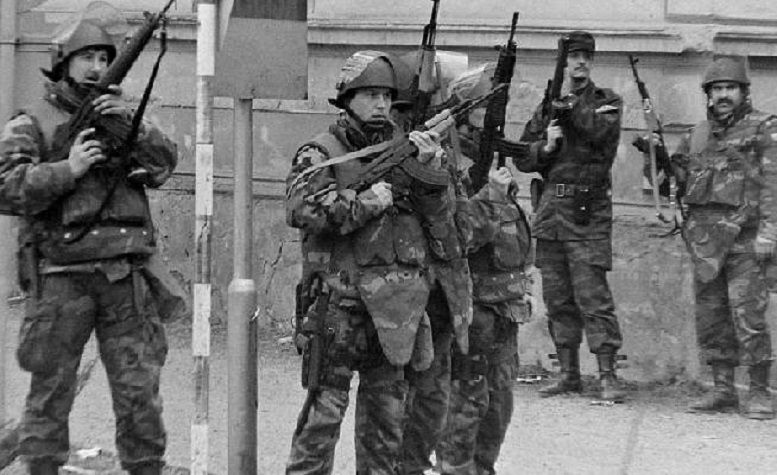
Croatian special policemen outside of the police station in Pakrac on 2nd
March 1991. The Croatian flag was removed from the building just one day before
this picture was taken. Source: Wikipedia
The
whole situation was experienced as escalating and very problematic for the
federal government which decided to act by ordering the army to intervene in
order to exercise authority and to act as a ”wall” between the Croatian
internal forces and Serb paramilitary. Intervention by the army was called in by
Borislav Jovic, a politician from Milosevic’s Socialist Party of Serbia (nationalists)
since Serbia during 1991 had the chairmanship over the Yugoslav presidency.
When the army units arrived in the city the situation was perceived as stable.
The Croatian special policemen and the JNA-personnel were stationed in
different parts of the area but also sometimes at close distance from each
other.
Croatian special policemen in Pakrac
2nd March 1991 .
Source:
Wikicommons
Aftermath
The verbal reactions by Tudjman were mixed. Partly
he said that those who were organizing the “coup” had the ambition to
reintroduce the “Bolshevist socialism”. At the same time, he and other representatives
of the government were making statements that the presence of JNA was justified
because the army had planned exercises in the area since before and in order to
“assist the internal forces to reinstate order”. Also, Mesic who at the moment was
the representative of Croatia in the Yugoslav presidency made statements that
the assignment of the army was to protect the republic. He began under 2nd March
to discuss with local JNA commanders and developed an agreement that JNA would
be stationed in the city while the special policemen would withdraw on 3rd
March. After the clash, the “everyday life” went back to its normal and JNA
personnel was conducting patrols in the city.
After large numbers of individuals who were members of SDS were arrested by
Croatian special policemen the negotiation process was started between the SDS
party and Tudjman’s government. Also, the USA ambassador Zimmerman participated
and had meetings with SDS members including Dzakula who said that Serbs had not
“succeeded from Croatia” and that they did not saw “succession as the only
desirable or acceptable solution”. SDS-representatives highlighted several
times that Serbs wanted to continue living in Croatia but only in a “democratic
Croatia within the Yugoslav federation”. [9]
It
has been considered that the meeting between the SDS and Croatian government
led to de-escalation of the crisis in Pakrac. [10] Another
important reason was the intervention of JNA. The army was able to take positions
in and around the city. After the Pakrac clash, Babic and Milosevic met in
Belgrade where they discussed the situation in Krajina. Babic was demanding
that Serbia would “protect Krajina” while Milosevic reassured him not to worry.
The leadership in Belgrade, just as in Zagreb, used the situation for its own
interests. With the help of regime friendly media, several statements were made that
Croatia’s government was threating the Serbs, using “fascist methods” and that
Croatia should be disarmed by force. Many media actors reported that in all-around 6 up to 40 persons were killed in Pakrac despite the total amount of
dead being equal to zero.
During
the period of May to June 1991 local referendums were taking place with agenda
if these areas should continue to remain part of Yugoslavia and break away from
Croatia. These referendums were organized by SDS and many of the party members
later participated in military actions together with JNA against the Croat
government. Developments in the municipality
of Pakrac were very similar to other local scenarios that resulted in the break out
of the war. The process was based on the model where the JNA would perform interventions
in parts of Croatia in order to “preserve the peace” and “prevent civil war”. [11]
Armoured
fighting vehicle and armoured car from JNA on patrol through Pakrac. Croatian
special policemen are standing to the right. Source:
Wikicommons
The
police station in Pakrac was attacked once more in August of 1991. The Serb forces took the municipality by
force and soon afterwards had to retreat when the Croatian forces retook the
control over the town. During the early autumn, Pakrac became once again under
Serb control and remained as part of RSK until May 1995. In the ICTY report
from 2001, it was stated that around 176 civilians were killed in Pakrac during
the fighting in 1991, many who were killed with “cold weapons” as knives and axes.
.[12]
References
[5] International
Court of Justice. Case Concerning. The Application of the Convention on the
Prevention and Punishment of the Crime of Genocide. (Croatia v. Yugoslavia).
Memorial of Republic of Croatia. Annexes. Regional Files. Volume 2. Part II.
Western Slavonia and Banovina. 1 March 2001. s.171
[7] Ramet
P. Sabrina. The Three Yugoslavia: State-building and Legitimation, 1918-2005.
(Bloomington, Indiana University Press, 2006) s.384
[8] Los
Angeles Times. Clash May Have Eased Yugoslav Civil War Threat : Balkans:
Tensions remain between Croats and Serbs. But officials' cooperative statements
suggest they hope to avoid a larger conflict. Publiceringsdatum:
Okänt. Nedladdat: 2016-09-20. Webbplats: http://articles.latimes.com/1991-03-05/news/mn-250_1_civil-war
[10] Caspersen, Nina
Fallentin. Intra-ethnic
competition and intra-ethnic conflict: Serb elites in Croatia and Bosnia
1990-1995. Publiceringsdatum:
Okänd. Nedladdat: 2016-07-15. Webbplats: http://etheses.lse.ac.uk/1907/ s.76